Monday, May 27, 2013

Bộ Sưu Tập Về Những Phương Thuốc Quý


Bức ảnh chụp ngược sáng ghi lại khoảnh khắc hậu vệ Chase Tapley của đội San Diego State (giữa) chuẩn bị tung ra một cú bấm bóng ghi điểm trước đội Syracuse tại giải bóng rổ sinh viên Mỹ ở San Diego đã để lại ấn tượng đẹp mắt
 
Mời đọc và ...tìm hiểu . . .có khi cần đến
 
Bộ Sưu Tập Về Những Phương Thuốc Qu


Khám Phá Mới:

Bệnh Sạn Trong Thận và Bệnh Ho (Thầy Phạm Đình Huy) 
 
 Bí Quyết:
 
Thực Phẩm & Dinh Dưỡng:
 
Y Khoa & Sức Khỏe:
 
Bao Tử (Đau Bao Tử)
 Bộ Não Khoẻ (Để Có Bộ Não Khoẻ) 
Bỏng (Cấp độ 1, 2 và 3) Cảm, Cúm (Triệu Chứng, Điều Trị) Cao Huyết Áp (Món Ăn Cho Ngưới Bệnh Cao Huyết Áp) Chán Đời (Bệnh Chán Đời) Chuột Rút (Chứng Chuột Rút, Tê Lạnh Ngón Tay, Chân) Đái Đường (Khái quát về Bệnh đái đường & Cách Chữa Trị) Đãng Trí (Thuốc Trị Bệnh Đãng Trí, Hay Quên!) Đi Bách Bộ (Sau Bữa Ăn Không Nên Đi Bách Bộ) Gan (Cà phê và trà làm giảm bớt nguy cơ bị hư gan) Giấc Ngủ (Thói Quen Không Tốt Cho Giấc Ngủ)Loét Dạ Dày (Nghệ và Mật Ong Chữa Bệnh Loét Dạ Dày) Mất Ngủ - Nguyên NhânMất Ngủ - Phương Pháp Vào Giấc Ngủ DễMắt Cườm, Mắt Có VảyMật Ong (Đa Năng Của Mật Ong) Mật Ong và Sắc Đẹp (Da hồng hào, trẻ đẹp tự nhiên) Mật Ong và Đời Sống (giúp tiêu hóa, Ho/cảm, đau cổ họng) Mùi Hôi Trong NgườiMụn CócMụn Nhọt (Cách Trị & Ngăn Ngừa) Nấc CụtNgáy Khi Ngủ (Tránh Ngáy Khi Ngủ) Nghẹt Mũi (Chữa Nghẹt Mũi Với Sinh Tố B5)Nghẹt Mũi và Nhiễm Trùng Khoang MũiNghệ và Mật OngNgộ Độc (Bột Than Chữa Được Chất Độc) Ngứa, Mề ĐayNgứa vào mùa lạnhNhói Tim Hay Chứng Ợ Nóng (Heartburn) Nhức Mỏi (Thần Dược Trị Nhức Mỏi: Sinh Tố B5) Nhức RăngNổi Nhọt Trong Miệng (Bị Nổi Nhọt Trong Miệng) Nôn MửaNứt Môi, Khô MôiNứt Nẻ Tay ChânNứt Nơi Góc Miệng (Bị Nứt Nơi Góc Miệng, Rách Khóe Môi) Ong Chích (Bị Ong Chích) Răng Sữa (Những Quan Niệm Sai Lầm Về Răng Sữa) Rụng Tóc (Để Tránh Rụng Tóc) Say SóngSẹoSình Bụng (Chứng Sình Bụng) Sổ MũiSỏi ThậnTai Biến Động Mạch Não (Cách Ngăn Ngừa) Táo BónTắt TiếngTê Lạnh Ngón Tay, Chân (Chứng Chuột Rút) Tiểu Đường (Những món dành cho người bệnh tiểu đường)Tiểu Són (Chứng tiểu són) Tóc Bị GầuTrí Nhớ Tốt (Để Cho Người Già Có Trí Nhớ Tốt)Vết BầmVết Chích, Vết Cắn Của Côn Trùng (Cách Chữa) Vết Ong ChíchVết Phổng Nước Trên DaVết Thương Ngoài DaViễn Thị (Chứng Viễn Thị, Mắt Lão) Ăn Uống & Bệnh Tật Có Liên Quan?
 
Cách Lấy Ráy Tai Không Đau


Phong Thấp


Sunday, May 26, 2013

Homegrown Medicinals

 
Homegrown Medicinals @ Common Sense Homesteading

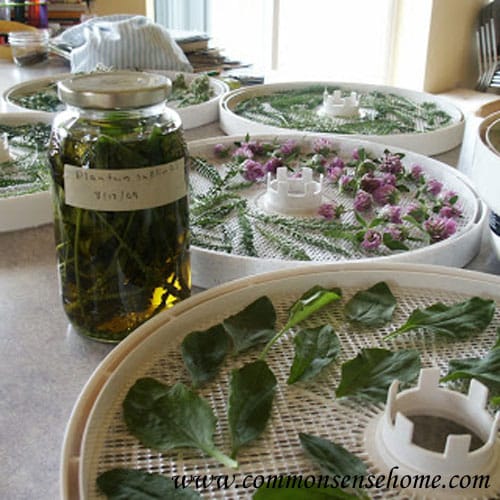
While I’m out working in the garden, I’m not just tending standard food crops, I’m also tending herbs and “weeds”.  Some I use for culinary purposes, some for medicinal, some for both.  (Don’t you love it when you can get multiple uses from one item?)  With many medicinal herbs now being outlawed in Europe, and increasing odds that the US is likely to follow Europe’s lead (thank you, Big Pharma), I’ve been learning more about plants that I can grow in my own yard for medicinal purposes.  You’d be surprised at how useful “weeds” can be.
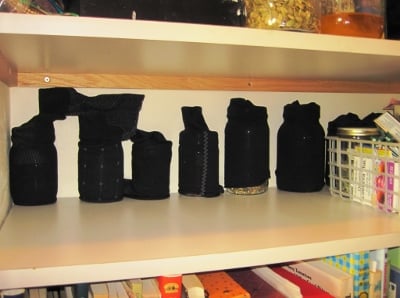
I dry an assortment of plants over the course of the season.  Most of them live in my pantry in glass jars covered with my husband’s old mismatched dress socks to keep out the light.  I cut each sock in half so it can cover two jars.  The socks are elasticized so they grip the jars nicely.  I always hated throwing one sock out when the other got worn through – now I have a use for them.  The food in front of them is kept in bins that can be easily pulled out to access the herbs.  You can see part of a bin on the right hand side of the photo.

covered herb storage

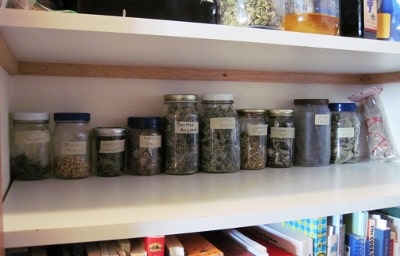
Here’s a shot of the naked jars.  I use whatever I have handy, from canning jars to empty jars from other foods, so they are a hodgepodge of sizes. I labeled them by writing with a sharpie marker on masking tape, including the contents and date stored. It’s cheap and easy.

uncovered herb storage

From left to right we have chocolate mint, mullein blossoms, lemon balm, red clover blossoms, yarrow, catnip, chamomile, raspberry leaf, hyssop, and mullein leaves.  That’s a bundle of sage in the corner.
The mints (chocolate mint, lemon balm, catnip) make lovely teas.  They are also good for soothing stomach troubles – cramping, gas, indigestion, vomiting, upset stomach, and colic in babies.  I drank mint tea during my pregnancy to help settle my stomach.
Mullein is used externally for treating ear ailments, and internally for treating congestion.  It helps to loosen mucus so it can be expelled from the body.  This post provides more detailed information on harvesting, drying and use of mullein.  Both the blossoms and the leaves can be used.
Red clover has an assortment of uses, many related to women’s health, including breast health, and helping with hot flashes and osteoporosis.  More details on red clover in Wildcrafting 101.
Yarrow is used against colds, cramps, fevers, kidney disorders, toothaches, skin irritations, and hemorrhages, and to regulate menses, stimulate the flow of bile, and purify the blood.  (More information in the post Real Healing Potions.) It’s a real powerhouse, but the taste leaves a lot to be desired.  Still, I keep it on hand, because you never know when you might need it.  Also, it grows abundantly (almost too abundantly) in my garden.  Be warned – it can spread like crazy.  I allow some of it to wander around, because it is supposed to help increase the essential oil content of herbs it is grown near and boost other plant’s disease resistance.
Chamomile is a general relaxant.  It makes a soothing tea, and can also be used in the bath.  To make a chamomile bath bomb, take a fabric scrap or old towel or hanky, place about 1/4 cup of dried chamomile in the center, tie with a ribbon and hang in the water stream as you fill your tub for a bath.  This can be dried and reused 2-3 times.
Raspberry leaf helps with many women’s health challenges, assisting from pregnancy to menopause.  It may also aid adrenal gland function.
Anise hyssop has a licorice taste that is often added to teas.  it was also used by Native Americans to treat coughs.
Another herb/weed that I use regularly that is not pictured here is plantain.  I use it most for skin irritations like mosquito bites and bee stings.  The results are nothing short of amazing.  For me, it works better than anythign else I’ve tried, including Benedryl spray.  In the post “Grandma Called it Medicine Leaf“, I describe harvesting plantain, using plantain fresh, and infusing plantain in oil.  I give instructions on “How to Make a Salve With Infused Oils“.  I like to keep the salve on hand for smaller spots like bug bites, and use the oil for larger areas like sunburns.
If you don’t grow or wildcraft your own herbal medicines, you may order seed and dried plant material from Mountain Rose Herbs (see link below).
Mountain Rose Herbs. A herbs, health and harmony c

There are dozens of weeds and herbs that are available to most of us.  I know I feel like I am barely scratching the surface.  This season I want to do more with nettles, dandelion, yellow dock, chickweed, shepherd’s purse, wild lettuce and who knows what else will present itself.  My favorite resource for herbal medicine thus far is the Holistic Herbal.  It has a photo with every herb description, and gives basic instructions for identification and use, as well as any concerns about use.  It’s sorted by herb and also by ailment, so you can search by whichever is most convenient for you.  Many of the herbs can be grown in my climate.  (I find it frustrating to read herbals where everything is imported from the far corners of the planet.)  It’s been a real eye opener for me just how many culinary herbs and weeds have medicinal properties.  I hope you’ll consider adding herbs and “weeds” to your preparedness storage, too.
Learn more about herbs, weeds and wildcrafting on the Herbs and Wildcrafting page.
This post has been added to Preparedness Challenge #9 and Domestically Divine.
Recommended for you
                      
                     
  •            


Wednesday, May 22, 2013

Cây Lá Cách (Premna serratifolia)

Premna serratifolia  L.

(Lamiaceae – the lavender family)

synonym:  Premna obtusifolia  R.Br.

Common names:  Creek Premna, Kaar
Premna
is from the Greek πρεμνον (premnon), the trunk or stump of a tree, referring to the dwarf stature of one species; serratifolia is from the Latin serratus, saw-toothed, and folium, a leaf. In the synonym, obtusifolia is from obtusus, blunt, and folium, a leaf.

This plant is native to various islands in the western Indian Ocean: Comoros, Mauritius, Réunion and the Seychelles. In temperate Asia it occurs in China, Taiwan, Japan and the Ryukyu Islands. In tropical Asia it is found in many parts of the Indian subcontinent, on the islands of the North Indian Ocean, and in most parts of Indo-China. It is native to almost everywhere in the East Indies and the Philippines. In Australia it occurs right across the top end, and down the east coast of Queensland, usually along watercourses or in seasonally wet areas, but it is also found in rain forests and vine thickets. It also occurs in parts of New Zealand. In the Pacific, it is native to the Marshall Islands, Palau, Fiji, New Caledonia, Samoa and the Solomon Islands. It has also become naturalized in various other parts of the world. The young tree photographed is in the Ergon yard at Picnic Bay.

  Creek Premna is a spreading shrub or small tree growing 2–6 m high. The leaves are opposite, 5–18 cm long, broadly ovate with a smooth leathery texture. They are light green in colour with prominent veins and the midrib raised beneath. The numerous flowers are cream-green in colour, with rather an unpleasant odour, borne on spreading terminal panicles about 10–20 cm across. The fruits are drupes, smooth, and globular in shape, 3–6 mm in diameter, dark blue to black when mature. The plant is propagated from seed.

Aborigines used this plant to treat the stings of stonefish and stingray, as well as spear wounds. Its use is widespread in the Pacific region for both medicinal and magical purposes. In the Marshall Islands, for instance, where the plant is called Kaar, it is used to cure various baby ailments, to improve people’s luck and to protect them from illness, and to make love potions. The leaves are used to cure ‘weakness of limbs’ and to alleviate headaches. Extracts made from the plant are often mixed with other herbal extracts in medicines.

  In the Chuuk Islands of Micronesia, young leaves are used to treat eye conditions such as styes. The leaves are chewed in the mouth of the person administering the treatment until they are a soft mush. This mush is then spat into the patients eye through a blowpipe made of a piece of pawpaw stem.

In other Micronesian Islands, especially in Pohnpei and Kosrae, the leaves are commonly used in steam baths, and a tea is also made by infusing the leaves, and used to treat coughs. Juice squeezed from the berries is used as nose drops to treat sinus headaches.
In fact, research is in progress on extracts from the bark and wood that contain alkaloids and iridoid glycoside, as these are believed to prevent cardiovascular disease.
In times of famine, the leaves and tender shoots can be cooked and eaten as greens.


Cây lá cách có nơi còn gọi vọng cách, thích mọc hoang nơi thềm ao, bìa rừng, vách núi... trên chân đất phèn lợ hay đất thịt pha cát. Đứng cách cây này khoảng 1-2 m, người thính mũi đã nghe tỏa mùi hăng hăng khó chịu. Càng lại gần, hơi lâu, người sức khỏe yếu dễ bị “mệt ngang”.
Theo ghi nhận của dược sĩ Trần Việt Hưng, “lá cách được dùng trong nhiều món ăn dân dã đồng thời cũng được xem là một “cây thuốc nam” dùng trị một số bệnh theo kinh nghiệm dân gian. Cây tuy có nguồn gốc tại vùng Nam Á Châu nhiệt đới nhưng cũng được trồng tại Hawaii, Florida (Hoa Kỳ). Lá cách thuộc chi thực vật Premna, họ Verbenacea. Chi Prem na có khoảng 200 loài, riêng tại Việt Nam có khoảng 15 loài trong đó có 4 hay 5 loài được dùng làm thực phẩm và làm thuốc.”
Cho nên, dân sành ăn tây nam bộ thường trồng vài bụi cách ngoài bờ mương, thềm rạch để dành chế biến nhiều món độc đáo. Cách mười ngày, nửa tháng họ chịu khó tỉa trụi cây cách, cho nó đâm nhiều chồi non mới. Lá cách non ít hôi hơn. Và khi gặp những vật thực có hậu vị tanh như: chuột, lươn, rắn... nó lại càng có khả năng “phù phép” cho chúng thơm tho.


http://www.kew.org/plants-fungi/Premna-serratifolia.htm

http://indianmedicinalherbs.blogspot.com/2009/03/premna-integrifolia-l.html