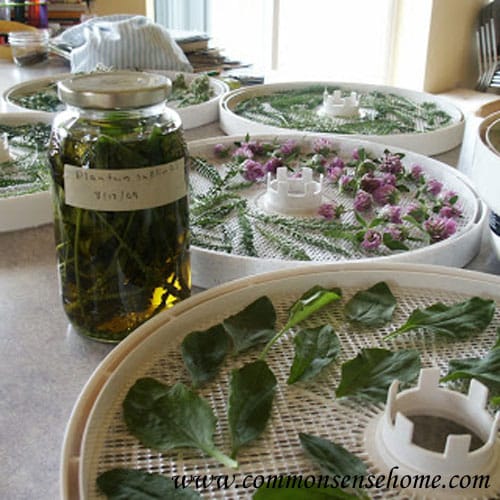
While I’m out working in the garden, I’m not just tending standard food crops, I’m also tending herbs and “weeds”. Some I use for culinary purposes, some for medicinal, some for both. (Don’t you love it when you can get multiple uses from one item?) With many medicinal herbs now being outlawed in Europe, and increasing odds that the US is likely to follow Europe’s lead (thank you, Big Pharma), I’ve been learning more about plants that I can grow in my own yard for medicinal purposes. You’d be surprised at how useful “weeds” can be.
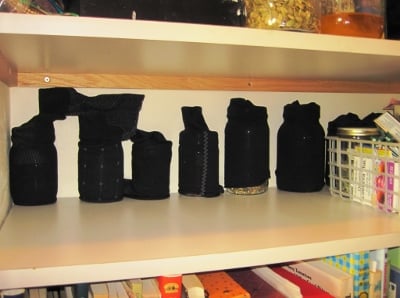
I dry an assortment of plants over the course of the season. Most of them live in my pantry in glass jars covered with my husband’s old mismatched dress socks to keep out the light. I cut each sock in half so it can cover two jars. The socks are elasticized so they grip the jars nicely. I always hated throwing one sock out when the other got worn through – now I have a use for them. The food in front of them is kept in bins that can be easily pulled out to access the herbs. You can see part of a bin on the right hand side of the photo.
Here’s a shot of the naked jars. I use whatever I have handy, from canning jars to empty jars from other foods, so they are a hodgepodge of sizes. I labeled them by writing with a sharpie marker on masking tape, including the contents and date stored. It’s cheap and easy.
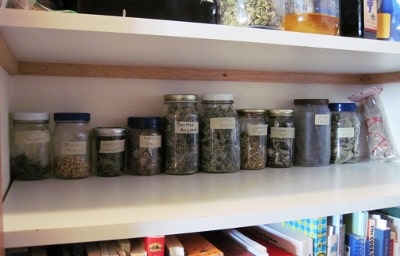
From left to right we have chocolate mint, mullein blossoms, lemon balm, red clover blossoms, yarrow, catnip, chamomile, raspberry leaf, hyssop, and mullein leaves. That’s a bundle of sage in the corner.
The mints (chocolate mint, lemon balm, catnip) make lovely teas. They are also good for soothing stomach troubles – cramping, gas, indigestion, vomiting, upset stomach, and colic in babies. I drank mint tea during my pregnancy to help settle my stomach.
Mullein is used externally for treating ear ailments, and internally for treating congestion. It helps to loosen mucus so it can be expelled from the body. This post provides more detailed information on harvesting, drying and use of mullein. Both the blossoms and the leaves can be used.
Red clover has an assortment of uses, many related to women’s health, including breast health, and helping with hot flashes and osteoporosis. More details on red clover in Wildcrafting 101.
Yarrow is used against colds, cramps, fevers, kidney disorders, toothaches, skin irritations, and hemorrhages, and to regulate menses, stimulate the flow of bile, and purify the blood. (More information in the post Real Healing Potions.) It’s a real powerhouse, but the taste leaves a lot to be desired. Still, I keep it on hand, because you never know when you might need it. Also, it grows abundantly (almost too abundantly) in my garden. Be warned – it can spread like crazy. I allow some of it to wander around, because it is supposed to help increase the essential oil content of herbs it is grown near and boost other plant’s disease resistance.
Chamomile is a general relaxant. It makes a soothing tea, and can also be used in the bath. To make a chamomile bath bomb, take a fabric scrap or old towel or hanky, place about 1/4 cup of dried chamomile in the center, tie with a ribbon and hang in the water stream as you fill your tub for a bath. This can be dried and reused 2-3 times.
Raspberry leaf helps with many women’s health challenges, assisting from pregnancy to menopause. It may also aid adrenal gland function.
Anise hyssop has a licorice taste that is often added to teas. it was also used by Native Americans to treat coughs.
Another herb/weed that I use regularly that is not pictured here is plantain. I use it most for skin irritations like mosquito bites and bee stings. The results are nothing short of amazing. For me, it works better than anythign else I’ve tried, including Benedryl spray. In the post “Grandma Called it Medicine Leaf“, I describe harvesting plantain, using plantain fresh, and infusing plantain in oil. I give instructions on “How to Make a Salve With Infused Oils“. I like to keep the salve on hand for smaller spots like bug bites, and use the oil for larger areas like sunburns.
If you don’t grow or wildcraft your own herbal medicines, you may order seed and dried plant material from Mountain Rose Herbs (see link below).

There are dozens of weeds and herbs that are available to most of us. I know I feel like I am barely scratching the surface. This season I want to do more with nettles, dandelion, yellow dock, chickweed, shepherd’s purse, wild lettuce and who knows what else will present itself. My favorite resource for herbal medicine thus far is the Holistic Herbal. It has a photo with every herb description, and gives basic instructions for identification and use, as well as any concerns about use. It’s sorted by herb and also by ailment, so you can search by whichever is most convenient for you. Many of the herbs can be grown in my climate. (I find it frustrating to read herbals where everything is imported from the far corners of the planet.) It’s been a real eye opener for me just how many culinary herbs and weeds have medicinal properties. I hope you’ll consider adding herbs and “weeds” to your preparedness storage, too.
Learn more about herbs, weeds and wildcrafting on the Herbs and Wildcrafting page.
This post has been added to Preparedness Challenge #9 and Domestically Divine.
Recommended for you


 synonym: Premna obtusifolia


